

Tattoos On Face Brands That Show Ownership In Sex Trafficking?
Content alert: This story contains details about violence and sexual set on.
Along a busy interstate near southeast Texas is a strip society, its neon sign lighting up the freeway. It sits windowless and vacant-looking during the day, another nondescript edifice near another fast-food joint near another used-auto lot. It's easy to pass by and forget, perchance not fifty-fifty find—unless yous're 1 of the women being quietly trafficked inside it.
"That'due south where I was," says Kathy, 31. She wears a fuzzy gray sweater, her makeup pristine, her nails manicured. Yous wouldn't guess that at one bespeak in time, she was the victim of sex trafficking or that her days were in one case a loop of rape and echo. Y'all wouldn't know that below her sweater is a 3-inch-tall tattoo of her pimp's nickname branded beyond her lower back, its thick black lines following her, moving with her, every single mean solar day.
It'due south estimated that nearly 5 million people globally are forced into sexual slavery each yr. It's a horrible reality that's only been made harder by groups like QAnon, whose connection to recent conspiracies (think: Pizzagate and #SaveTheChildren) have hijacked the human-trafficking narrative and detracted from actual victims who need aid.
We need to pay attention. These are existent numbers, real people, and real bodies. Almost all of these victims conduct brands like Kathy's, inked beyond their necks, artillery, inner thighs, breasts, sometimes even their face or lips. The tattoos take the form of flowers, names, barcodes, and gang affiliations. Some of them say "slut" or "fuck" or "daddy's girl." But they all hateful the same affair: buying.
Even when victims manage to become out and establish new lives, new identities, their traumas are notwithstanding etched into their peel, leeching into their relationships, self-worth, and sense of normalcy. In early 2020, Cosmopolitan followed 3 of these branded survivors on their journeys to remove their ink and finally untether themselves from their by. These women chose non only to share their stories just also to testify their faces and tattoos in an effort to raise awareness and advocate for others.
This is the actual narrative—this is what information technology looks like to repossess your body.
I was hungry the night my trafficker had me branded. But I was always hungry then—skinny girls sold improve, so Billy* fed me only cheese and cigarettes. "I don't want another man's name on you," he said looking at my old tattoo, the brand from my first trafficker. He promised my new ink would be small, simply I didn't care—we both knew I didn't take a say over my body anymore.
I was sold to Baton by some other pimp when I was eighteen, although I didn't really know it. I had never heard of human trafficking before. I grew up poor in an abusive home—my childhood had a lot of domestic crime and sexual set on, simply I didn't know those things had names. I didn't fifty-fifty learn that I had been trafficked until nine months after I was rescued. I but assumed I was another street girl.
Billy's word was law. The first fourth dimension I talked dorsum to him, he broke my nose and cracked my ribs. I thought he was going to kill me. From then on, I was Billy'southward doll: He dressed me in tiny clothes and forced me to wearable pinkish lipstick and platinum hair extensions. He shipped me across the U.S. for dissimilar men to abuse me. He beat me. He branded me. He chosen me Peaches.
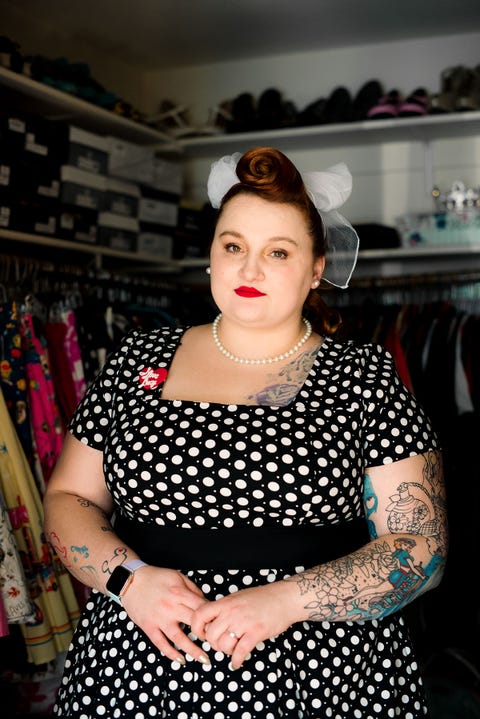
And he also lied. Baton had me branded in a damp garage that reeked of dried urine and ash. I sat in a metal chair while a homo with a tattoo gun freehanded a rose under my clavicle. All of Baton's girls had flowers, I after learned—I was just another in his drove.
Every bit the needle fleck into my mankind, Billy sabbatum nearby on his telephone, his hand resting lightly on his gun. With each pass of the needle, the tattoo grew—a flood of uneven stars snaking upwards my chest, dollar signs and exclamation marks edging over my nipple. Information technology wasn't small. Five hours later, Billy paid for the tattoo with me. The man raped me where he had branded me, my tattoo bleeding against the cement while Billy watched from his chair.
I couldn't look in the mirror afterward. Even later escaping three years later, I wasn't really free—Baton was always in that location. Whenever I saw my reflection or took off my clothes or caught sight of my make, I felt him there, dominating my torso. I tried to hide the tattoo under turtlenecks and T-shirts, but it always peeked through. "That'due south beautiful," a stranger once complimented, asking what it meant. Bile rose in my throat. Each fourth dimension someone commented on my tattoo, each time I mumbled a throwaway response or snapped back about the realities of human trafficking, I felt tired and broken, similar my body had been permanently ruined.
When my daughter was born years later, I cradled her on my chest, amazed I'd created something and so precious. Seeing her face made me realize I had never actually known what real, unmanipulated dearest felt like. A friend photographed the moment and sent me the pic. At that place was my infant, sweet and pure, lying in the eye of my make. It was horrible. I didn't want her to associate me with this hateful piece of history as she grew up—I wanted information technology gone.
Tattoo artists told me they could encompass it up with a blackness-and-white pattern, but I didn't want to add together some other ugly thing to my skin, and I didn't want more questions near my body. Eventually, Breaking the Chains, a survivor nonprofit, matched me with a salon offer free make removal for survivors. My first session was unbelievably painful. The technician gave me topical numbing cream, but the light amplification by stimulated emission of radiation still hurt worse than the years of cracked ribs and broken noses. Worse than my C-section. Information technology felt like my chest was being doused in hot grease once more and again, and as I tried to hold notwithstanding, I kept thinking, Why exercise I have to go through this? Why did this happen to me?
Initially, the salon estimated I'd need 10 to 12 laser sessions, so I thought I'd be finished in a little over a year. That was 3 years ago. They say the ink that was used for my brand was poorly manufactured, which makes information technology even harder to remove. At this point, I'thou looking at another one to two years of sessions until I'm finally done.
Even though my brand is still visible, I experience different, like a dimmer switch has been turned down. I used to exist so afraid of wearing makeup or looking pretty, but I've slowly discovered that I really have a love of brilliant lipstick and vintage dress. I started volunteering with a vintage-wearing group of women that helps underserved communities. They've not only shown me that I have a lot to offer outside of being a survivor, but they've also helped me feel cute again.
I sometimes think of the other women who are out there right at present, wearing flowers like mine. I wonder if they've gotten theirs covered up or lasered off, if they're free, if they're not. I've learned that my make isn't who I am or who I want to be, but even still, I'k looking forward to information technology being gone. I don't desire to stay covered up anymore.
I recall the first time I really wore makeup: I couldn't effigy out what was supposed to go where. I was a teenager, but a tomboy, who had grown up playing basketball and video games, not doing makeovers with friends. Then when my exploiter gave me a pocketbook of makeup and instructed me to put it on, I struggled. I knew enough from movies to figure out the mascara, just the rest of it was a puzzle. So he did it for me. He blended eyeshadow over my lids and painted my lips with gloss, making me presentable for the next human being to rape me.
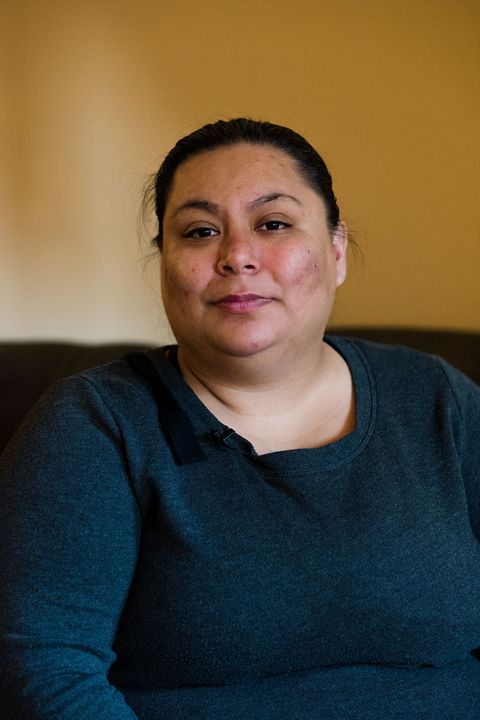
Women go to make modest decisions nigh their appearance every single twenty-four hour period, like how to do their eyebrows or whether to wear their hair upward or downwards, only I didn't have a choice in how I looked for almost a decade. I got trapped when I was 19, and I didn't become out until I was 27. I had at least ten exploiters during that time, each with their ain agenda, their own routines, their own forms of torture. I had to buy specific brands of makeup, vesture certain shades, and match my expect to the outfits they picked out for me.
By the time I was forced to get branded, I was numb to it. It nigh didn't feel similar my body anymore. A man came into the hotel room, grabbed my arm, and tattooed the nickname of one of my traffickers on it. He added a heart on top. I barely registered any of information technology. A few years ago, a coworker asked about my make, and I didn't know what to say. I detest being marked as someone's possession. Smitty had wanted the tattoo in a place where it would e'er be visible when I was on the streets, and I'1000 still living with that reminder years subsequently.
When I ended up pregnant by an exploiter, Smitty released me. He didn't want the hassle. But I all the same wasn't gratuitous. Local traffickers abducted my babe, refusing to return him until I made them enough money. Something in me knew so I had to get out, even if I had nowhere to get.
When I got my son back, a neighbor drove me to a safe house run by Love Never Fails. They helped me figure out how to live once again—not just learning how to cook or get a driver's license just learning how to shake a homo'south hand and not feel afraid. Ninety-five per centum of the time at present, I don't wearable makeup; I don't wear jewelry. I wear my hair in a bun, considering I like my hair in a bun.
A few years agone, I started getting laser treatments through Jerome Potozkin, Dr., a dermatologist who offered to remove my brand for free. The tattoo has faded a lot since then, but the visual effects still become to me. Some nights, I'll run across information technology and become flashbacks, and I'll have to stop myself from calling the office considering it'south 10 p.m. and the function is closed, and my mind is in a different place.
I don't necessarily dream of big things anymore. My goal is simply to maintain independence for me and my son and to go on my success and pass it on to the next survivor. I didn't think of a future when I was being exploited—all I wanted to practice was leave live. And now I accept a one-sleeping room flat, a full-time chore in network engineering, and, soon, a life that'll exist free of branding. I just want to embrace what I've been given and assist somebody in the same manner. That'southward my dream now.
I was a college freshman when I started dating Sean*, the pb vocalist of a band in Texas at the fourth dimension. Everything about him felt fun and glamorous—he had local celebrity hookups, he was charismatic, he had clout, and he had chosen me. And then when he asked me to get a nickname tattooed on my lower dorsum almost a year into our relationship—"so people know you're mine"—I thought it was romantic.
And that'south what happens when you're groomed past a trafficker: Yous don't see the carmine flags. You let someone tattoo cake letters onto your body in some dirty studio, because you've been manipulated into believing that'south what beloved is. Trafficking had always seemed to me like some faraway thing that merely happened overseas. I didn't know information technology could also happen—and does happen—to girls similar me. I had a good upbringing filled with church and community service. I studied difficult. I was in the ROTC. I was informed. I thought I was safe. Withal I was and then under Sean'due south control that I didn't even realize I had merely been branded to be sent out on the streets.
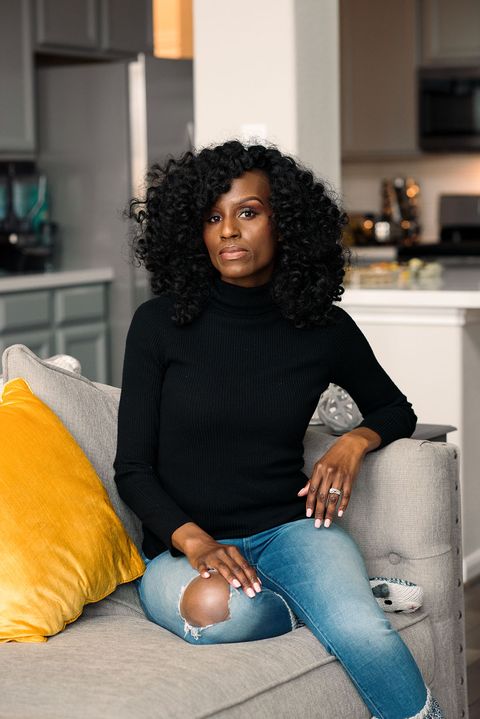
He asked me to continue a business trip with him in northern Texas, and when I walked into our hotel room and saw the strangers waiting to rape me, I knew my life had only irreversibly changed. The adjacent nine months were lived through out-of-body experiences. Sean morphed from a mannerly man, a human being I thought loved me, into someone who beat me, immune men to choke me, rape me, corruption me. He said he'd injure my family if I left. And I wasn't lonely—Sean had other girls with me, all wearing some version of his brand tattooed beyond their neck, chest, and breasts.
I want people to know that rescue is not an event—it's a process. My brother managed to go me out ane night, but it wasn't really over. Sean even so came after me, saying he owned me, and if I didn't believe him, look in the mirror. "No ane else is going to want you," he'd say. "When they bear upon you, they'll but see me." My body felt foreign. I couldn't get away from it, this permanent symbol of what he'd done to me, what he'd let strangers do to me. Men I dated would comment on the brand, saying they couldn't believe I had a "tramp stamp." I felt worthless for a very long time.
I paid a tattoo creative person to ink a butterfly and "God'southward Holding" around the brand, but I notwithstanding couldn't look at my torso in the mirror. No matter what I wore, or how much better my life got, I could even so feel a piece of me tethered to the filth and abuse. I wanted it gone, not merely covered up, but at $300 to $500 a session, laser removal wasn't in my budget. And so I met Paul Friedman, MD, a local dermatologist who, subsequently hearing about the astringent trafficking problem in Texas, offered me complimentary light amplification by stimulated emission of radiation removal.
My first appointment was emotional. Each pass of the laser took me dorsum to those days with Sean, my mind flashing through the corruption, the men, the pain. Later the dermatologist bandaged me upward, I walked out to my car and cried. I've had 2 sessions and so far, and they've thankfully gotten easier. Sitting there and watching the ties to my past go physically severed has helped me heal. I'yard not sure people realize how imprisoning a brand can exist—it chains a piece of y'all to the darkness forever. But having those letters removed, seeing them slowly burn away and fade, has given me back my identity.
Last summertime, I got married in a chroma-pink wedding ceremony dress—custom-altered to hide my brand. My guests wore white to stand for purity, and the room felt like information technology was suspended by angels. For a long time after existence trafficked, I didn't believe I was worthy of anyone's beloved. Simply equally I walked toward my husband that day, I felt like I was also walking abroad from my past. He promised that I could trust him and depend on him, vowing to never ever hurt me, and in that moment, equally the months of abuse flooded through me, I felt like I was finally being released.
If yous suspect homo trafficking, please report it. The National Human Trafficking Hotline ( 888–373–7888) accepts confidential calls.
*Sure details, names, and events in these stories take been condensed and/or changed for clarity and anonymity.
Arien, Tish, and Kathy deeply want to thank the post-obit doctors, dermatologists, and advocacy groups that made their make removal possible:
Doctors and salons:
Advancement groups/nonprofits:
For more information on getting your brand removed or covered upwardly or about helping this cause, delight contact:
Concepted and edited by Chloe Metzger. Photographs by Valerie Chiang. Produced by Raydene Hansen. Video by Janet Upadhye. Video editing by Heather Weyrick. Motion graphics and pattern by John Francis.
This content is created and maintained past a third party, and imported onto this page to aid users provide their email addresses. Yous may be able to find more than information about this and similar content at piano.io

Tattoos On Face Brands That Show Ownership In Sex Trafficking?,
Source: https://www.cosmopolitan.com/style-beauty/beauty/a34743566/sex-trafficking-branding-tattoos-survivor-stories/
Posted by: johnsonaffeekly.blogspot.com
0 Response to "Tattoos On Face Brands That Show Ownership In Sex Trafficking?"
Post a Comment